
The Discipline of Reinforcement: Process Takeaways from the Boomer Circle Summit


Process themes at the 2026 Boomer Circle Summit centered around the idea that growth doesn’t force firms to trade quality for speed, or structure for flexibility. Strain comes from the informal, undocumented systems many firms rely on to hold quality together as they scale.
Accountability is a structure you build
Amanda Wilkie of Perigee Performance opened her session, Process Accountability: Scaling Quality Without Slowing Down, by pointing out that informal quality control breaks down as firms add offices and service lines. Wilkie's framework separates three roles that firms tend to conflate.
An owner is accountable for the outcome
Contributors execute the steps day to day
Approvers (a group kept deliberately small) sign off on changes
Most quality problems come up at handoff points when work passes from one person or team to another, because no one is accountable for what happens there.
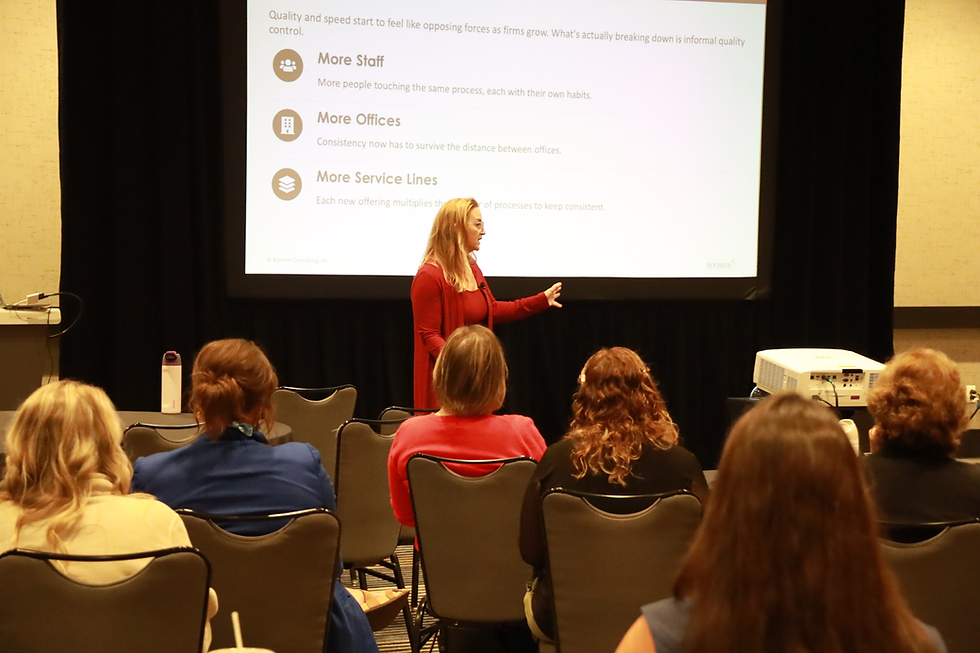
Wilkie explained what should stay fixed and what can flex. Core steps, including required documentation and handoff points, stay the same no matter who does the work. But firms should document judgment zones that allow for intentional discretion, so team members know where they can use judgment. She closed with a caution against treating structure as self-sustaining. A named owner and a well-documented process depend on change management, the discipline of reinforcement that keeps a new process alive past its first week.
Deanna Perkins of Boomer Consulting picked up the accountability thread from the culture side in her session, Building an Innovation-Driven, Accountable Culture. Her premise is that when a good idea comes up and nothing happens, that’s a culture problem, not an innovation problem. Perkins named five barriers that keep ideas from bubbling up at all, including:
Fear of failure
Constant busyness
Perfectionism
Leadership bottlenecks
A lack of ownership
She recommended a fix that reframes what performance reviews measure and moves the question from whether someone finished their work to whether they improved it.
Capacity is a design problem
Arianna Campbell, Chief Operating Officer at Boomer Consulting, reframed a familiar complaint in her session, Unlocking Capacity: Elevating Your People to Higher-Value Work. She argued most firms have effort to spare, but lack usable capacity because skilled people spend time on work that doesn't require their judgment or experience. Campbell called this a work-design issue rather than a staffing issue. Instead of asking how to get people to do more, ask what work should a person no longer do so they can contribute at a higher level?
Her framework includes four levers for moving work off the wrong desk:
1. Delegate it with clear expectations and decision rights
2. Automate the manual and repetitive pieces
3. Outsource essential work that doesn’t require internal talent
4. Apply AI to research, drafting and document processing
Without a plan, Campbell said capacity created through any of the four levers tends to get reabsorbed by more of the same work and old habits. That’s why we need to deliberately protect that capacity and redirect it toward coaching, advisory conversations or process improvement.
Change only sticks with reinforcement
Nakesha Woods, Director of Learning and Development at Rehmann, closed the loop with her session, Change that Sticks, which looked at why transformation efforts stall after a strong launch. Woods organized the common failure points into four categories: a lack of understanding and buy-in, a lack of clear direction, a lack of motivation and a lack of support once the change is underway.

She recommends separating commands from collaborative changes. Some decisions are non-negotiable and need a clear why. Others benefit from input before you finalize them. Firms that treat every change like a command risk losing buy-in.
She also recommends distinguishing suggestions from expectations. “We're going to try this” and “this is now part of how we work” produce very different adoption rates for the same initiative. Woods tied process, culture and change together by pointing out that sustainment depends on building the change into existing processes, naming an owner after launch and reviewing feedback on a set cadence.
What this means for your firm
Across all process-focused sessions at this year’s Summit, process improvement looked less like a project with an end date and more like an operating habit. To make the habit stick, firms need to name an owner, protect the judgment zones, redesign the work before adding headcount and reinforce the change long after the kickoff meeting ends.
Could you benefit from structure and accountability as you strive to push your firm forward?
The Boomer Process Circle is a peer group of top Process and Lean Six Sigma leaders in the accounting profession who share tools and resources for pushing change within their firms. Apply now to tap into the experience and expertise you need to lead the charge for continuous improvement.


Comments